Anthony "Amp" Elmore reveals 12th‑century Malian Bògòlanfini was transformed into an Obama Mud Cloth Tuxedo now honored in the Obama Presidential Library calling it Kwanzaa's ultimate African cultural diplomat to African Cultural Diplomacy
MEMPHIS, TN, December 26, 2025 /24-7PressRelease/ -- In Memphis, Tennessee Anthony "Amp" Elmore A NARA Honored Historian singled handedly created Memphis 1st and only "Black Memphis History Museum." Click here to visit the museum titled blackmemphishistory.com. According to U.S. Census Bureau's 2019-2023 estimates Memphis as the largest majority Black population in America.
Anthony "Amp" Elmore is Memphis born 5-Time World kickboxing champion is fighting Memphis White Supremacy, Racism and Black on Black racism against the Memphis culture and practice of the erasure of "Black Memphis History."
Anthony "Amp" Elmore explains: "Anthony "Amp" Elmore was the 1st to bring E.S.P.N. to Memphis in 1981" whereas Elmore wrote produced directed and starred in not only Memphis 1st Independent 35mm Theatrical film titled "The Contemporary Gladiator" our film is the 1st Kickboxing film in world film history whereas the Memphis and Shelby County film Commission and the Shelby County Historical Commission used their function and authority to erase our Memphis film history noting our film as Memphis 1st Independent 35mm theatrical film.
At the corner of G.E. Patterson and Main street in Memphis a Historical marker notes the 1989 film release title "Mystery Train" is listed as Memphis 1st Independent 35mm film. The 1988 Anthony "Amp" Elmore Film titled "The Contemporary Gladiator is not listed in Memphis film history.
Click here view a video titled: Memphis 1st Independent Film The Contemporary Gladiator & Racist Historical Marker
Anthony "Amp" Elmore is in a fight in Memphis for "Education and Representation." Elmore is fighting Memphis White Supremacy, Racism and Black on Black Racism challenging racist systems in Memphis to Honor the Historic African American Community of Orange Mound as the birthplace of the "Quintessential Symbol of Kwanzaa."
Click here to view an August 6, 2024 National News release titled: Memphis World Kickbox Champ & filmmaker Elmore Ask Memphis Mayor Paul Young to Give Black History & Culture a Chance
Memphis, Tennessee is America's most populated city of Blacks whereas Memphis has a cotton museum and no Black Memphis history museum. In 1978 during the Memphis police and fire strike the Wall Street journal described Memphis as "A Backwards city with a plantation Mentality."
On July 11, 2009, President Barack Obama addressed the Parliament of Ghana in Accra, delivering a speech that redefined U.S.-Africa relations by emphasizing partnership over patronage. Moving away from traditional rhetoric focused solely on foreign aid, President Obama asserted that "Africa doesn't need strongmen, it needs strong institutions." He praised Ghana as a democratic model for the continent and challenged African nations to take primary responsibility for their own development by eradicating corruption and upholding the rule of law.
The address was balanced by an acknowledgment of the historical scars of colonialism and the slave trade—symbolized by his visit to Cape Coast Castle—while remaining firmly focused on the future. Obama's message was particularly directed at the **youth of Africa**, calling on them to seize the opportunity to build more transparent and prosperous societies. By centering the conversation on good governance, the speech signaled a shift in American foreign policy toward supporting "capacity building" and sustainable democratic growth across the continent.
Prior to President Obama traveling to Ghana Anthony "Amp" Elmore a Memphis born 5-Time World Kickboxing Champion, community activist and Memphis 1st Independent 35mm Theatrical Filmmaker wrote President Obama a detailed 9 page letter. Elmore offered advice to President Obama regarding African and African/American relationships.
Click here to view the Anthony "Amp" Elmore June 30, 2009 9 page letter to President Obama
On July 14, 2009 days after returning from Ghana President Obama wrote Anthony "Amp" Elmore a thank you note whereas Anthony "Amp" Elmore presented President Obama an African Styled Mudcloth Tuxedo to President Obama whereas President Obama promised Elmore via communication to Memphis Congressman Steve Cohen that the Tuxedo would be placed in the Barack Obama Presidential Library.
Click here to see the July 14, 2009 thankyou letter President Obama Sent to Anthony "Amp" Elmore
Fast forward to December 2025. President Obama kelp his word to Anthony "Amp" Elmore whereas the Tuxedo Anthony "Amp" Elmore made for President Obama is showcased in the Barack Obama Presidential digital Library. Anthony "Amp" Elmore explains that the Barack Obama Mud Cloth Tuxedo represent the quintessential symbols of all principles of Kwanzaa.
Click here to see the Mudcloth Tuxedo Featured in the Barack Obama Digital Library.
Kwanzaa is a week-long cultural holiday celebrated from December 26 to January 1st that serves as a way for African Americans to honor their African heritage and reinforce community bonds. Kwanzaa is based on (Seven Principles) called the Nguzo Saba. The 7 principles The seven principles of Kwanzaa, known as the Nguzo Saba 1. **Umoja** (Unity) 2. **Kujichagulia** (Self-determination) 3. **Ujima** (Collective Work and Responsibility) 4. **Ujamaa** (Cooperative Economics) 5. **Nia** (Purpose) 6. **Kuumba** (Creativity) 7. **Imani** (Faith)
In concert with President Obama traveling to Ghana on July 11, 2009 Anthony "Amp" Elmore held a celebration at his Orange Mound home to honor President Obama's visit to Ghana.
Click here to view the July 10, 2009 Memphis Congressman Steve Cohen's honoring Anthony "Amp" Elmore's efforts to support President Obama visit to Ghana.
Anthony "Amp" Elmore boldly declares via his efforts to establish relationships with Africa and African countries his African/American Community of "Orange Mound in Memphis is "The Birthplace of African Cultural Diplomacy" and he Anthony "Amp" Elmore is "The Father of African Cultural Diplomacy."
Anthony "Amp" Elmore coined a new term he calls "Quintessential Kwanzaa." Anthony "Amp" Elmore explains "Quintessential Kwanzaa" is not just a word it's a reality. Elmore explains that the "Quintessential Kwanzaa" is honored and represented by NARA or the "National Archives and Records Administration."
In 1933 the father of African/American history Dr. Carter G. Woodson published the book "The Mis-Education of the Negro." Dr. Carter G. Woodson argues that the American education system functioned as a tool of social control rather than liberation for African Americans. His central message is that Black students were being "culturally indoctrinated" to admire Eurocentric achievements while being taught to despise their own history and potential.
On December 7, 2025 a ceremony was held in Memphis as one Anthony "Amp" Elmore describes as one of social control and miseducation whereas a historic marker installed in the historic Memphis African/American community of Orange Mound noting the community was formed in 1890, Anthony "Amp" Elmore argues, "The Black Community of Orange Mound was started in 1879 and not 1890. Dr. Carter G. Woodson wrote: "Those who have no record of what their forebears have accomplished lose the inspiration which comes from the teaching of biography and history."
Click here to view a December 20, 2025 22 minute video titled: Anthony "Amp" Elmore NARA Honored Historian Dispels Orange Mound 1890 birth Myth Correct date is 1879
Anthony "Amp" Elmore challenges the Orange Mound sign that reads: Orange Mound established in 1890 via concrete proof that Orange Mound began in 1879 and not 1890.
Click here to see a video titled: New Orange Mound Sign Racist: Truth Revealed by Anthony "Amp" Elmore
In America from December 26th to January 1st is the celebration of the African/American holiday called Kwanzaa. Anthony "Amp" Elmore explains that we in "Orange Mound via our Barack Obama Mudcloth Tuxedo marks the paradigm of a Kwanzaa milestone whereas the Barack Obama Mudcloth Tuxedo is the Quintessential Symbol as the meaning of "Kwanzaa."
Click here to read a March 7, 2012 National News Release titled: President Obama's 2013 Inaugural Tuxedo Is Already in Production
In the March 7, 2012 News Story a sentence reads: Elmore who had a paid for home and store was so convinced regarding creating jobs and industry in both Africa and America that he mortgaged his life away by creating the 1st "All African Home in America."
Anthony "Amp" Elmore explains we can talk about Kwanzaa all day long, but Anthony "Amp" Elmore can show not just the essence of Kwanzaa, Anthony "Amp" Elmore can show the embodiment of Kwanzaa represented via our lives whereas the "National Archives and Records Administration" honored what Anthony "Amp" Elmore defines as "The Obama Mudcloth Kwanzaa Tuxedo."
Elmore notes our Mud Cloth Tuxedo in the Barack Obama Presidential Library is the embodiment of the "Quintessential Kwanzaa Symbol"
Anthony "Amp" Elmore declares the "Quintessential Kwanzaa" is the 2008-2009 Bògòlanfini (Mud Cloth) Tuxedo Jacket his company presented to President Obama is the Living and breathing "Quintessential Kwanzaa."
In common sense terms Anthony "Amp" Elmore created a Kwanzaa milestone, whereas the "National Archives and Records Administration" recognized a 21st Century fashion of African heritage — created by African hands — preserved in the highest archive of American presidential history.
Anthony "Amp" Elmore explains that the greatest injustice perpetrated on people of African descent was not only just slavery and the erasure of African culture and history what was the most devastating harm to people of African descent was the Tarzan creation.
The story of Tarzan is America's most destructive image of Africa is rooted in the way the character institutionalized the "White Savior" myth. By suggesting that a white man—solely by virtue of his "noble" European blood—could master a continent and its people more effectively than those who lived there for generations.
Edgar Rice Burroughs the Tarzan creator reinforced the ideology of "White Supremacy" In this narrative framework, Tarzan is not just an adventurer; he is a symbol of biological determinism, asserting that even a man raised by apes is inherently superior to the Black people surrounding him.
The portrayal Tarzan systematically dehumanized the African continent by reducing its vast diversity to a monolithic, prehistoric "jungle" inhabited by "savages" and "cannibals." By erasing the existence of complex African kingdoms, trade networks, and intellectual history, the Tarzan stories provided a powerful cultural justification for Western colonialism.
The imagery of Tarzan suggested that Africa was a chaotic vacuum of leadership that required European intervention to find order. This "Dark Continent" trope became the primary lens through which millions of Americans viewed Africa, replacing reality with a dangerous, fictionalized landscape of peril and primitivism.
The psychological impact of these images was particularly devastating for the African Diaspora in America. As leaders like Malcolm X and Muhammad Ali pointed out, the relentless depiction of Africans as spear-carrying caricatures forced Black Americans to choose between identifying with a hero who looked like their oppressor or villains who looked like themselves.
This created a deep sense of psychological alienation and shame regarding African heritage. Even modern attempts to sanitize the story often fall into the trap of erasure, treating the continent as a mere backdrop for white self-discovery while marginalizing or entirely removing African voices from their own land.
The Anthony "Amp" Elmore African Tuxedo stands as a monumental shift in the visual language of Black identity, representing what many consider the highest and most elegant fusion of African dignity and Western fashion standards.
The garment was specifically designed for President Barack Obama following his historic 2008 election. Elmore, who had already established the first "All-African" home in America, directed his team in Ghana to source authentic Mudcloth from local markets.
Unlike the more commonly known Dashiki or the Nigerian Grand Boubou, this tuxedo was engineered to integrate 12th-century Malian tradition with the formal structure of a Western tuxedo, creating a "Styled African" aesthetic that demands respect in the most elite corridors of power.
The choice of Mudcloth (Bògòlanfini) is deeply symbolic, as the fabric dates back to the ancient Kingdom of Mali. Elmore's selection of specific patterns representing wealth and royalty was a deliberate act of cultural reclamation, designed to bring the richness of Timbuktu and the Mali Empire into the White House. This effort was part of Elmore's "Safari Initiative"—an acronym for "Styled African Fashion Application Renaissance Initiative."
By repurposing the Swahili word "Safari," which had been popularized by Ernest Hemingway through a colonial lens, Elmore reclaimed the term to describe a modern African renaissance. The tuxedo serves as a bridge between the ancient world and the 21st century, asserting that African heritage is not merely "traditional" or "folkloric," but is a standard of global excellence.
Furthermore, the presence of this garment in the Obama Presidential Library archives marks it as a "Quintessential Kwanzaa" symbol, perhaps the most significant in the holiday's history. For Elmore, the tuxedo is a tool for connection; it links the first African country to gain independence, Ghana, to the ancient mound-building civilizations of America.
Anthony "Amp" Elmore posits that the name "Orange Mound" in Memphis refers to ancient Black Mali Mound builders who predated Columbus, thereby grounding African American history in a lineage that is both indigenous to the Americas and rooted in the soil of Mali.
In this context, the tuxedo is an act of resistance against ignorance and systemic racism, challenging the "Tarzan" myths of the past by replacing them with an image of sophisticated, high-culture African identity.
The story of the Anthony "Amp" Elmore Obama Tuxedo is not merely a chronicle of a garment, but a saga of "Quintessential Kwanzaa"—a transformation of ancient African intellectual property into a modern instrument of global power.
For decades, the American celebration of Kwanzaa has often felt like a perfunctory exercise, sometimes creating a "cultural shock" for many middle-class African Americans who find the barefoot dancing and folk-style costumes disconnected from their professional lives. While Kwanzaa is designed to uplift African/Americans attending a Kwanzaa celebration and image of Africa is only seeing drumming and bare foot dancing nothing elegant notes a distorted view of Africa and Africans.
While the traditional Kwanzaa celebrations attempt to bridge the gap to the continent, they often inadvertently reinforce the "primitive myth or Africa being only that on a jungle" Anthony "Amp" Elmore explains that when African Americans witness anything Africa we only see people dancing with a drumming with no short and shoes.
Anthony "Amp" Elmore shattered this paradigm by conceptualizing a 12th-century Malian textile science, **Bògòlanfini**, not as a costume, but as a sophisticated "Power Suit." By configuring this Mudcloth into a tuxedo—the universal uniform of the global elite—Anthony "Amp" Elmore created the first Kwanzaa symbol that speaks the language of the boardroom, the State Dinner, the Oval Office and elegance.
The Barack Obama African styled tuxedo represents the ultimate milestone in African Cultural Diplomacy because it achieved what no other Kwanzaa article has ever done: it reached the pinnacle of the American government whereas the African Mudcloth Tuxedo made for President Obama is preserved via the National Archives and Records Administration.
In 2008, as the world watched the historic election of Barack Obama Jr. America's 1st Black President Anthony "Amp" Elmore saw an opportunity to manifest "African Cultural Inclusion" the Kwanzaa principle of **Umoja (Unity)** by connecting a Black American President to his ancestral roots through elite Ghanaian craftsmanship. Although President Obama was bound by protocol to wear a Union-shop tuxedo for his inauguration, he recognized the profound significance of the Elmore creation of an African Mud Cloth Tuxedo.
President Obama understood that his wearing an African styled Tuxedo for his inaugural ball would have created a distraction and noted by 1st Lady Michelle Obama via here current book titled "The Look." Michelle Obama explains why she never wore braids in the White House Ahead of releasing her new style book, "The Look," the former first lady reflects on skipping braids in the White House and owning her look today. The former 1st Lady notes that wearing braids at the White House would have become a "political distraction."
Whereas in 2008 Anthony "Amp" Elmore created a Mudcloth Tuxedo for President Obama understanding that wearing such a garment would have been a "political distraction" the White informed Memphis Congressman Steve Cohen whom delivered the Mud Cloth Tuxedo to the White House that the Tuxedo would be placed in the Barack Obama Presidential Library.
The President's official commitment to place the Mudcloth tuxedo in the **Barack Obama Presidential Library** was a validation of the highest order. It signaled that African workmanship and small-business ingenuity were not just "gifts" to be tucked away, but historical treasures worthy of the same preservation as the most sacred documents in the National Archives and Records Administration (NARA).
The "Quintessential" nature of this tuxedo lies in its ability to embody all seven principles of the Nguzo Saba simultaneously. It is **Kujichagulia (Self-Determination)** because Elmore dared to define the President's image on African terms; it is **Ujamaa (Cooperative Economics)** because it utilized the labor and talent of the Mali and Ghanaian small business to produce a designer-level garment; and it is **Nia (Purpose)** because its entire existence was designed to foster a trade renaissance between Africa and its Diaspora.
The Most important Kwanzaa principle the African Mudcloth Tuxedo represents is the sixth principle Kuumba (Creativity), the sixth principle, which means "to do always as much as we can, in the way we can, in order to leave our community more beautiful and beneficial than we inherited it."
For the first time, a Kwanzaa symbol moved beyond the living room and into the digital archives of history. In December 2025, as the tuxedo is showcased in the **Obama Digital Library**, it stands as the first presidential library to exist in a purely digital, global space, making this garment accessible to Black people worldwide. It is an honor that transcends borders, showing that an item made in Africa can hold the same prestige as any luxury brand in the West.
Ultimately, the Obama Tuxedo serves as the "Ultimate Kwanzaa Key" because it removes the "performative" barrier and replaces it with "prestige." It offers an entry point for those who may never attend a traditional Kwanzaa ceremony but who feel a deep, visceral pride in seeing African fashion at the highest level of human achievement.
By linking this creation to both Kwanzaa and **Black History Month**, Anthony "Amp" Elmore has established himself as the "Father of African Cultural Diplomacy," proving that the "African Spirit" is a 12th-century legacy that is still sharp enough to dress a President. This is more than a story of fashion; it is a story of honor, where a garment made for a Black President by a Black historian became a permanent beacon of hope for the global African family.
Click here to read a February 18, 2025 International News Release titled: From Slaves to Kings: The True Legacy of Orange Mound "Amp" Elmore seeks to Empower the Memphis Black Community of "Orange Mound" via Education & Reclaiming America's Afro-Indigenous & African History
When the 100% African‑made Mud Cloth Tuxedo entered the Barack Obama Presidential Library and the National Archives, it became the first African-inspired garment connected to a U.S. President preserved as a national artifact.
That single placement ties Orange Mound's legacy of Black self‑determination to the Obama era's symbolism of progress and representation, while simultaneously giving Kwanzaa its first nationally archived presidential‑level cultural symbol. In effect, the tuxedo becomes the meeting point: Kwanzaa's values, Orange Mound's historic Black agency, and President Obama's global legacy are now permanently linked in the federal record.
Read the full story here: https://www.24-7pressrelease.com/press-release/530173/anthony-amp-elmore-narahonored-historian-declares-his-obama-mud-cloth-tuxedo-the-quintessential-artifact-embodying-all-seven-principles-of-kwanzaa-and-advancing-african-cultural-diplomacy
Press Release Service and Press Release Distribution by 24-7 Press Release Newswire
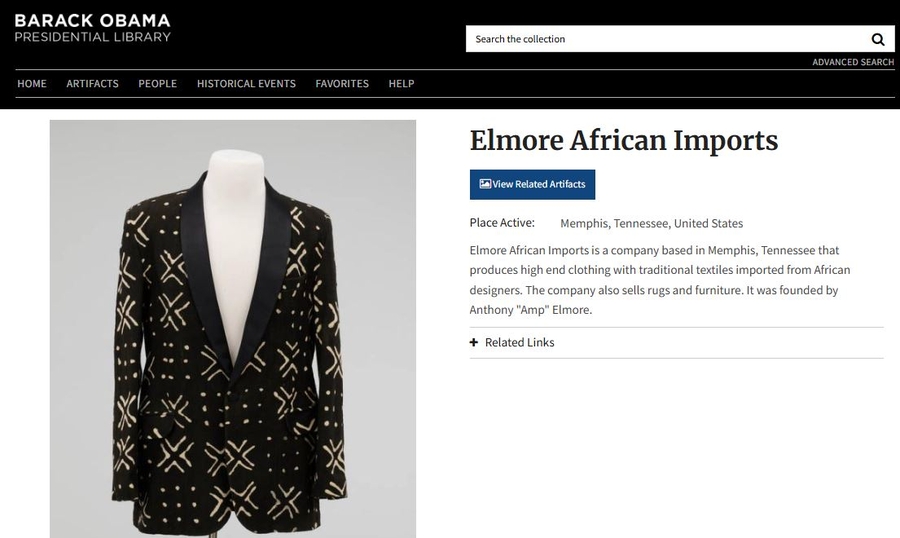
Anthony "Amp" Elmore, NARA‑Honored Historian, Declares His Obama Mud Cloth Tuxedo the Quintessential Artifact Embodying All Seven Principles of Kwanzaa and Advancing African Cultural Diplomacy
24-7 Press Release Newswire