
Villandry Home & Outdoor Living has issued guidance for property owners on inspecting and maintaining outdoor surfaces during a summer in which much of New Hampshire has remained in drought.
The New Hampshire Department of Environmental Services reported that the state entered spring 2026 with all of it in dry or drought conditions, and that slightly more than half remained in dry or drought conditions at the end of June. Several monitoring wells in southern New Hampshire sat at or near historic lows for the month. Water levels in wells north of the White Mountains had recovered fully, while conditions in the southern part of the state were expected to persist through at least September.
Figures published by the United States Drought Monitor in late July showed roughly a quarter of the state under active drought, with a further portion classified as abnormally dry. The categories in place ranged from moderate drought across most of that area to severe drought in a smaller share of it. Reporting in June placed severe conditions across parts of Hillsborough and Merrimack counties, along with Belknap and Strafford.
Precipitation records give that some context. According to figures cited by the state, most of New Hampshire typically receives four to five inches of rain in June, with July totals generally lower across the southern half of the state. June 2026 brought normal to above normal precipitation to much of the state, though the seacoast area received less than three quarters of its normal amount, and the department noted that stream levels are transient and do not by themselves signal the end of drought.
State guidance issued alongside those findings asked residents to reduce nonessential water use, naming lawn watering, car washing and pressure washing among the activities to cut back. That last item bears directly on exterior surfaces, since pressure washing is a common seasonal maintenance step for decks and patios.
"Water restrictions change what maintenance looks like for a season," said Rich Villandry, Co-Owner of Villandry Home & Outdoor Living. "It is a reason to look at what a surface actually asks for over its life, rather than only what it looks like on the day it goes in."
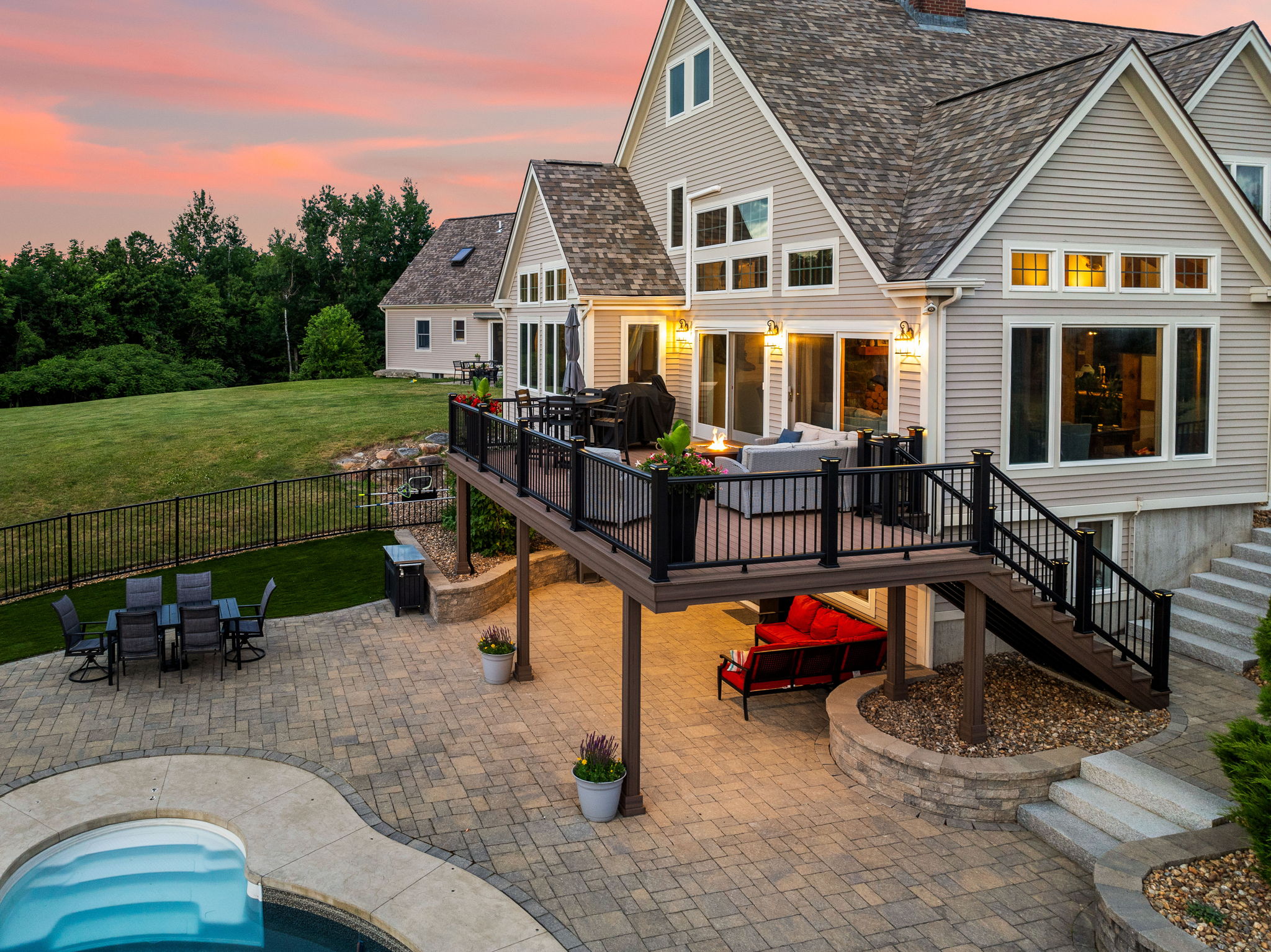
Maintenance requirements differ by material. Composite and PVC decking are manufactured products with published care instructions, and those instructions generally describe periodic cleaning rather than the refinishing cycle other exterior materials require. Guidance written for a specific product line governs the work, and it varies between lines even within a single brand.
Dry weather also makes visual inspection easier. With less debris held on the surface by rain, boards, fasteners, railings, stairs and visible framing connections can be examined more readily. Changes at fastening points and at the connection between the deck and the house are the details worth noting, since these are where movement across successive seasons tends to appear first.
The properties that matter across a full New Hampshire year are addressed in ASTM D7032, the standard that establishes performance ratings for wood-plastic composite and plastic lumber deck boards, stair treads, guards and handrails. Its testing covers temperature and moisture effects, ultraviolet resistance and freeze-thaw resistance, among other properties. Sustained ultraviolet exposure through a dry summer is one of the conditions that testing accounts for.
Those conditions rarely arrive in isolation. A dry summer in New Hampshire is followed by a winter of freezing temperatures, snow accumulation and repeated freeze and thaw cycling, and exterior materials pass through the full range within a single year. The standard notes that composites should not be assumed to behave in the same way as wood, which is part of why product-specific instructions carry more weight than general rules.
Water management beneath a deck forms part of the same picture. Under-deck drainage systems route water away from the framing rather than allowing it to pass between the boards, which keeps the area below dry enough to use and limits sustained moisture contact with the structure. Systems of that kind are planned alongside the framing rather than added to a completed deck.
Villandry Home & Outdoor Living installs composite and PVC decking over steel framing and does not install wood decking. Projects run from planning through the final walkthrough, with three-dimensional design modeling used to settle material selection and layout before construction begins.
"Most of what determines how a surface holds up gets decided before anyone picks up a tool," Villandry said. "Material, framing and how the whole thing sheds water are settled at the planning stage, and they are difficult to revisit later."
Villandry Home & Outdoor Living is a family owned design-build firm that has built custom decks, porches, patios and outdoor living spaces in New Hampshire since 1997. Founded by Rick Villandry, the company is a Deckorators Certified Pro and a Fortress Building Products Alliance Member, installing composite and PVC decking, steel framing, railing, under-deck drainage systems, porches, patios and pergolas.
###
For more information about Villandry Home & Outdoor Living, contact the company here:
Villandry Home & Outdoor Living
Richard Villandry
+16038108180
rvillandry@gmail.com
165 Baboosic Lake Rd, Merrimack, NH 03054, United States
